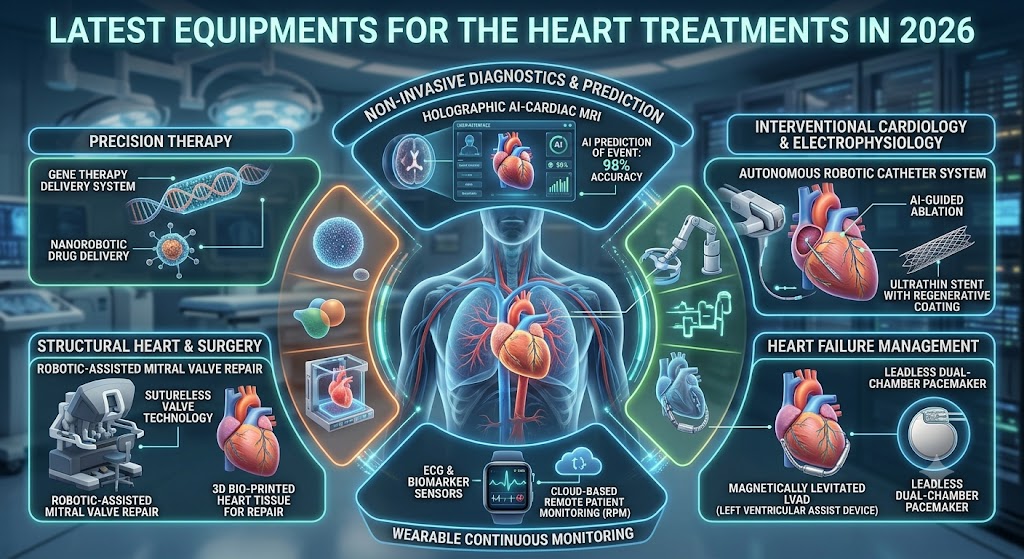
Latest Equipments For The Heart Treatments in Kolkata in 2026
The Heart of Innovation: Latest Equipment for Heart Treatments in Kolkata (2026)
Imagine your heart as a beautiful, tireless engine. It beats over 100,000 times a day, pumping life through your body. But just like any engine, it sometimes needs a bit of expert care, tuning, or repair. For decades, the phrase “heart surgery” triggered immense anxiety—visions of large chest incisions, prolonged hospitalizations, and months of painful recovery.
Medical technology in 2026 has transformed that reality. In Kolkata, a city globally recognized for its deep cultural roots, a quiet yet massive healthcare revolution is taking place. The city’s premier medical institutions—such as the Rabindranath Tagore International Institute of Cardiac Sciences (Narayana Health), BM Birla Heart Hospital, Apollo Multispeciality Hospitals, and Desun Hospital—are now utilizing world-class cardiac equipment.
Treating a heart condition in 2026 is no longer solely about heavy, invasive procedures. It is about precision, miniature devices, and intelligent systems that allow cardiologists to repair the heart through tiny, pinhole entry points.
This comprehensive guide breaks down the latest equipment and technologies available for heart treatments in Kolkata in 2026, explained in simple language so you can make informed decisions for yourself or your loved ones.
Advanced Structural Heart & Valve Equipment
The heart contains four vital valves that act as one-way doors, keeping blood flowing in the correct direction. When these valves narrow (stenosis) or leak (regurgitation), the heart has to work twice as hard. In 2026, Kolkata’s leading cardiac centers use groundbreaking equipment to fix these “doors” without opening the chest.
Transcatheter Aortic Valve Implantation (TAVI) Systems
-
What it is: TAVI is a specialized system used to replace a diseased aortic valve. Instead of cutting open the breastbone, doctors use a highly sophisticated, flexible catheter delivery system.
-
How it works: A collapsed artificial valve (made of natural tissue supported by a metal frame) is loaded onto a thin, long tube called a catheter. Guided by high-resolution live imaging, the cardiologist inserts the catheter through a small puncture in the groin artery and threads it all the way up into the heart. Once positioned inside the old, damaged valve, the new valve is expanded. It immediately takes over the job of regulating blood flow.
-
Why it matters: Patients who are elderly or too weak for traditional open-heart surgery can now have their heart valves replaced in under an hour. They are often walking by the next day and discharged within 48 to 72 hours.
-
Where to find it in Kolkata: Narayana Health (RN Tagore), Desun Hospital, and Apollo Multispeciality Hospitals.
MitraClip & Transcatheter Edge-to-Edge Repair (TEER) Devices
-
What it is: This equipment is designed specifically for a leaking mitral valve (mitral regurgitation). Think of it as a microscopic, cloth-covered clip that mends a leaky valve door.
-
How it works: Similar to TAVI, the MitraClip is guided into the heart via a catheter through the femoral vein. Once inside the left atrium, the physician uses real-time 3D echocardiography to precisely position the clip, clamping the loose or leaking valve leaflets together so they close properly.
-
Why it matters: It stops blood from flowing backward into the lungs, instantly reducing shortness of breath and extreme fatigue without requiring the patient to be placed on a heart-lung bypass machine.
Next-Generation Interventional Cardiology & Artery Clearance Equipment
When arteries supplying blood to the heart muscle become choked with cholesterol and calcium plaques, it causes chest pain (angina) or heart attacks. While angioplasty and stenting have been around for a long time, the equipment used in 2026 makes these procedures incredibly precise and highly permanent.
Intravascular Lithotripsy (IVL) – “The Heart Shockwave”
-
What it is: Historically, if an artery was hardened by heavy calcium deposits, drilling it out was risky. IVL uses sound waves—similar to the technology used to break up kidney stones—to safely crack internal calcium.
-
How it works: A specialized balloon catheter connected to a portable generator is placed inside the blocked artery. Once in position, the balloon is inflated softly, and the equipment delivers localized acoustic shockwaves. These shockwaves break up the rigid calcium within the artery wall while leaving the soft, healthy tissue completely unharmed.
-
Why it matters: It turns a rock-hard, unyielding blockage into a soft, treatable channel, allowing the cardiologist to easily deploy a stent safely with a minimal risk of tearing the blood vessel.
Orbital & Rotational Atherectomy Systems (Rotablation)
-
What it is: For arteries with stubborn, superficial calcifications, advanced atherectomy equipment acts as a microscopic, diamond-tipped drill.
-
How it works: The system utilizes a tiny, diamond-coated crown or burr that spins at incredibly high speeds (up to 140,000 to 160,000 RPM). It sands away the hard calcium into microscopic particles smaller than red blood cells, which are safely washed away by the bloodstream.
-
Why it matters: It prepares the blood vessel for a stent in complex cases that conventional balloons cannot open.
High-Resolution Intravascular Imaging: IVUS and OCT
-
What it is: Instead of relying just on traditional 2D X-ray angiograms, cardiologists in Kolkata now look inside the artery walls using Intravascular Ultrasound (IVUS) or Optical Coherence Tomography (OCT).
-
How it works:
-
IVUS: Uses a tiny ultrasound probe on the tip of a catheter to give a 360-degree cross-sectional sound-wave image of the artery.
-
OCT: Uses near-infrared light beams to create ultra-high-definition, microscopic images of the vessel interior.
-
-
Why it matters: It acts like an internal microscope. It tells the doctor exactly how thick the blockage is, what it is made of, and ensures that the deployed stent is perfectly expanded against the wall, virtually eliminating the chances of the stent failing or clotting in the future.
Revolutionary Heart Failure & Rhythm Management Devices
When the heart beats too slowly, too fast, or lacks the strength to pump blood effectively, specialized electronic implants are used to restore its natural rhythm.
Leadless Pacemaker Systems
-
What it is: Traditional pacemakers involve a metallic pocket under the collarbone skin and long wires (leads) threaded down into the heart. A leadless pacemaker is a self-contained device that is roughly the size of a vitamin capsule.
-
How it works: The tiny capsule contains both the battery and the computer chip. It is guided up through a groin vein using a catheter and securely anchored directly inside the right ventricle of the heart. It requires no surgical pockets or wires.
-
Why it matters: There are no visible lumps under the skin, no surgical scars, and absolutely zero risk of lead broken wires or pocket infections—which were the main complications of older pacemakers.
-
Where to find it in Kolkata: Desun Hospital, BM Birla Heart Hospital, and Apollo Multispeciality Hospitals.
+-------------------------------------------------------------+
|               TRADITIONAL VS. LEADLESS PACEMAKER            |
+-------------------------------------------------------------+
| Feature             | Traditional Pacemaker | Leadless     |
+---------------------+-----------------------+--------------|
| Size                | Pocket-watch size     | Vitamin cap  |
| Surgical Scar       | Yes (Near collarbone) | None         |
| Wires (Leads)       | Yes (Threaded to heart)| None        |
| Insertion Point     | Upper Chest Incision  | Groin Puncture|
+-------------------------------------------------------------+
Subcutaneous Implantable Cardioverter-Defibrillators (S-ICD)
-
What it is: For patients at risk of sudden cardiac arrest due to dangerous, chaotic heart rhythms, an ICD acts as an internal emergency responder. The Subcutaneous version keeps everything outside the ribcage.
-
How it works: The device is implanted just under the skin at the side of the chest, and the sensing wire runs beneath the skin right over the breastbone, completely leaving the heart and blood vessels untouched. If it detects a lethal rhythm, it delivers a life-saving electrical shock to reset the heart.
-
Why it matters: Because no wires enter the vascular system or the heart muscle, it completely protects the blood vessels from damage and reduces long-term procedural risks.
Advanced Robotic-Assisted & Minimally Invasive Surgery Equipment
For cases where a physical repair is mandatory and cannot be done via simple interventional catheters, surgical technology has shifted toward robotic automation and miniature incisions.
Robotic-Assisted Surgical Systems (e.g., DaVinci Xi)
-
What it is: A multi-armed robotic console that allows a cardiac surgeon to perform complex open surgeries through tiny, keyhole incisions between the ribs.
-
How it works: The surgeon sits at a highly advanced ergonomic console a few feet away from the patient, viewing the inside of the chest via a 3D high-definition camera system that magnifies the field up to 10 times. The surgeon’s hand, wrist, and finger movements are translated in real-time into precise, micro-movements of tiny surgical instruments inside the patient.
-
Why it matters: The machine filters out even the slightest human hand tremors. Because the breastbone does not need to be sawed open, patients experience significantly less bleeding, drastically reduced pain, and can return to active life within 2 to 3 weeks rather than the traditional 3 months.
-
Where to find it in Kolkata: BM Birla Heart Hospital and Apollo Multispeciality Hospitals.
Step-by-Step: What a Modern Cardiac Procedure Looks Like in 2026
To understand how seamlessly these tools work together, let us walk through a step-by-step journey of a patient undergoing a modern, image-guided coronary angioplasty in Kolkata today:
Step 1: Pre-Procedure Planning via 192-Slice Cardiac CT
Before entering the operating room, the patient undergoes a lightning-fast scan using a 192-Slice Cardiac CT Scanner. This equipment generates a pristine, three-dimensional map of the moving heart, pinpointing blockages before a single incision is made.
Step 2: Entering the Digital Hybrid Cath Lab
The patient is taken into a state-of-the-art Hybrid Catheterization Laboratory (Cath Lab). This room combines a sterile operating theatre with advanced robotic X-ray arms that move fluidly around the patient to capture real-time, multi-angle moving images.
Step 3: Pinhole Access via Radial Artery
The area is numbed with local anesthesia. Instead of the groin, the specialist uses a tiny needle puncture in the wrist (Radial Artery approach). This minimizes discomfort and allows the patient to sit up and eat right after the procedure.
Step 4: Internal Microscopy (OCT Scan)
A hairline catheter tipped with near-infrared light (OCT) is inserted to look inside the clogged artery. The doctors read the scan on a high-definition monitor, determining the exact nature of the plaque.
Step 5: Clearing the Blockage (IVL Shockwave)
If the blockage is calcified, the Intravascular Lithotripsy balloon is slid into position, safely cracking the hard calcium with sound waves.
Step 6: Deploying the Smart Drug-Eluting Stent
A next-generation Drug-Eluting Stent (DES) coated with medication is expanded at the site. The medicine slowly releases into the vessel wall over several weeks to ensure the tissue heals cleanly without scarring or re-clogging.
Step 7: Final Verification and Quick Recovery
The OCT imaging is run one last time to verify the stent is open and seated flawlessly. The catheter is pulled out, a small wristband band is applied to stop bleeding, and the patient walks back to their recovery room, frequently heading home the very next morning.
Choosing the Right Cardiac Facility in Kolkata
If you or a family member requires advanced heart care, look for hospitals that house these specific units:
-
Dedicated 24/7 Interventional Cath Labs: Essential for emergency primary angioplasties during an active heart attack.
-
Advanced Cardiac Imaging Suite: Ensure they have IVUS, OCT, and multi-slice CT capabilities for precise diagnosis.
-
Dedicated Cardiac Critical Care Units (CCU): Backed by round-the-clock specialized cardiac intensivists and advanced life support machinery like ECMO (which acts as a temporary external heart and lung).
Conclusion
The landscape of heart treatments in Kolkata in 2026 is filled with safety, precision, and rapid recovery. Thanks to these advanced medical instruments, what used to require major open-chest surgery can now often be completed through a small puncture wound. Technology has bridge-built a path where treating your heart is smoother, faster, and safer than ever before.