Complex Coronary Intervention: Advanced Solutions for Severe Heart Blockages
Advanced procedural expertise dedicated to safely treating the most severe, calcified, or challenging heart blockages.
Complex Coronary Intervention in Kolkata, India
Expert High-Risk Heart Care with Dr. Ayan Kar
Receiving a diagnosis of severe, advanced, or “high-risk” heart blockages can be a deeply unsettling experience. In some cases, patients are told that their arteries are too heavily calcified for a standard stent, or that their blockages are too complex for a routine procedure. Sometimes, they are informed that traditional open-heart bypass surgery is their only option—or worse, that their condition is simply inoperable.
If you or a loved one are facing this frightening scenario, we want you to know that there is hope. Medical technology and surgical techniques have advanced leaps and bounds over the past decade.
Welcome to the specialized field of Complex Coronary Intervention.
Led by Dr. Ayan Kar, our clinic provides advanced procedural expertise dedicated to safely treating the most severe, calcified, or challenging heart blockages. We specialize in utilizing cutting-edge, minimally invasive techniques to restore blood flow in situations where standard angioplasty is simply not enough.
Our mission is to give you a second chance at a healthy, active life, avoiding the trauma of open-chest surgery whenever possible. If you are looking for the most reliable Complex Angioplasty Treatment in Kolkata, this comprehensive guide will explain everything you need to know about these advanced procedures, how they work, and what to expect during your journey to recovery.
What is a Complex Coronary Intervention?
To understand what makes a procedure “complex,” it helps to first understand a standard angioplasty.
In a standard angioplasty, a patient usually has a straightforward blockage made of soft, fatty plaque. The cardiologist guides a thin tube (catheter) to the heart, inflates a tiny balloon to squish the soft plaque against the artery wall, and leaves a metal mesh tube (a stent) in place to keep the artery open. It is a highly effective, routine procedure.
However, the human body is complicated, and heart disease does not always develop in a simple, straightforward way. Over many years, blockages can become incredibly severe. The plaque can harden into bone-like calcium. The blockages can occur at tricky intersections in the blood vessels, or an artery might be 100% blocked for months or even years.
Standard balloons and standard techniques cannot fix these severe issues. A balloon will simply pop if it tries to push against a rock-hard, calcified blockage.
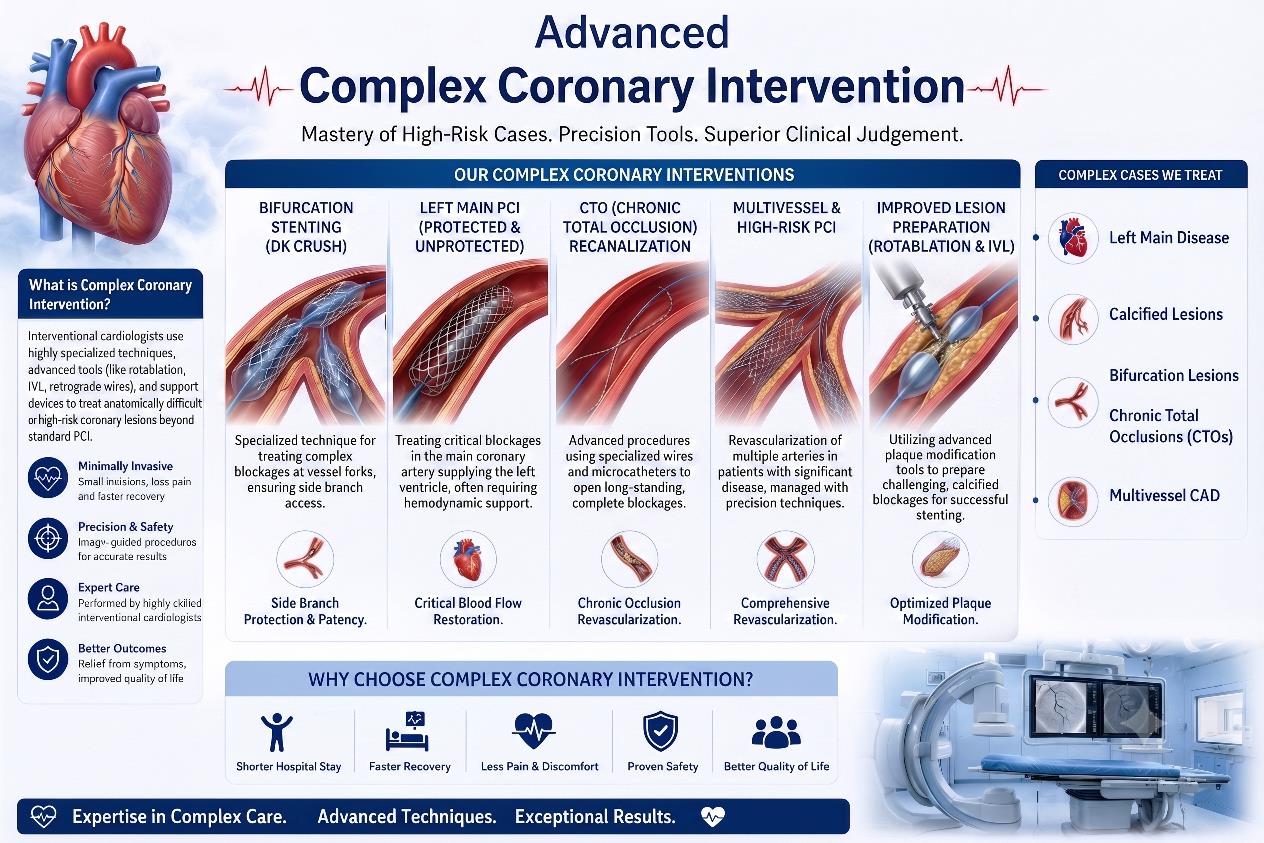
Complex Coronary Intervention (also known as High-Risk PCI or Percutaneous Coronary Intervention) refers to a specialized set of advanced skills, sophisticated micro-tools, and high-definition internal imaging technologies used to treat these incredibly difficult cases. It requires a highly trained interventional cardiologist who possesses the technical mastery to navigate, drill, and rebuild severely diseased arteries from the inside out.
When is Complex Angioplasty Required?
Dr. Ayan Kar evaluates every patient’s heart meticulously to determine the safest and most effective approach. You may require a High-Risk PCI Procedure Treatment in Kolkata if your angiogram reveals any of the following challenging conditions:
1. Heavily Calcified Lesions (The “Concrete” Blockages)
As plaque sits in an artery over time, the body can deposit calcium into it. Eventually, this plaque turns from a soft, sticky substance into a rigid, rock-hard shell that is virtually identical to bone or concrete. Standard angioplasty balloons cannot crack this calcium. Attempting to force a stent into a calcified artery is dangerous, as the stent will not fully expand, which can lead to life-threatening blood clots later on. Treating these “concrete” blockages requires specialized drilling or sound-wave technology to shatter the calcium before a stent can be safely placed.
2. Chronic Total Occlusions (CTO)
A CTO is an artery that has been 100% completely blocked for three months or longer. Blood flow has completely stopped through this pipe. In the past, bypass surgery was the only way to treat a CTO. Because the blockage is solid and old, a standard guidewire cannot simply pass through it. Treating a CTO requires extraordinary patience, specialized ultra-stiff microscopic wires, and advanced techniques to literally tunnel through the solid blockage or carefully navigate completely around it through the microscopic layers of the artery wall.
3. Bifurcation Lesions (The “Y-Junction” Blockages)
Your coronary arteries are not just straight lines; they branch out like the limbs of a tree to cover the entire heart muscle. A bifurcation lesion occurs when plaque builds up exactly at the point where one artery splits into two—forming a “Y” shape. Treating this is like trying to repair the plumbing at a complex joint. It often requires placing two separate stents that interlock perfectly without crushing each other or blocking the side branch. It takes precise geometric planning and expert hands.
4. Left Main Coronary Artery Disease
The Left Main coronary artery is the most critical blood vessel in the body. It supplies more than two-thirds of the blood to your entire heart muscle. A blockage here is often referred to as the “widow-maker” because a sudden closure is almost always fatal. Historically, any disease in the Left Main artery mandated open-heart bypass surgery. Today, with the aid of advanced heart pumps and precision imaging, a highly skilled Angioplasty Doctor in Kolkata like Dr. Kar can safely stent the Left Main artery, offering a life-saving, minimally invasive alternative to major surgery.
5. Multi-Vessel Disease
Instead of just one blockage, some patients have severe disease spread across all three of the major arteries feeding the heart. Fixing this requires a strategic, staged approach, sometimes addressing the most critical blockages first, and returning weeks later to fix the rest, carefully managing the patient’s overall health and kidney function throughout the process.
Advanced Technologies Used in Complex Interventions
The secret to successfully treating high-risk blockages lies not just in the skill of the doctor, but in the state-of-the-art tools they utilize. As a leading Doctor for High-Risk PCI Procedure in Kolkata, Dr. Ayan Kar employs the most advanced technologies available in the world today.
1. Intravascular Ultrasound (IVUS)
A standard X-ray (angiogram) only shows the shadow of the inside of the artery. It is a 2D picture of a 3D problem. IVUS changes everything. Dr. Kar threads a microscopic ultrasound camera directly inside your artery. This provides a crystal-clear, 360-degree cross-sectional view of the blood vessel from the inside. It tells the doctor exactly how much calcium is present, exactly how wide the artery truly is, and ensures that the stent is expanded perfectly against the wall with zero gaps.
2. Optical Coherence Tomography (OCT)
Similar to IVUS, OCT is an advanced imaging camera that goes inside the heart. However, instead of sound waves, OCT uses near-infrared light to take ultra-high-definition, microscopic pictures of the artery walls. The resolution is so sharp that Dr. Kar can see the individual layers of the artery and tailor the stent placement with millimeter precision.
3. Rotational Atherectomy (Rotablation)
When facing a heavily calcified “rock-hard” blockage, Dr. Kar uses a Rotablator. This is a microscopic drill bit coated with tiny diamond crystals. Guided precisely to the blockage, the drill spins at ultra-high speeds (up to 160,000 revolutions per minute). It gently acts like sandpaper, safely shaving away the hard calcium into microscopic particles smaller than red blood cells, which are safely washed away by the body. Once the calcium is drilled out, a stent can easily slide in and expand.
4. Intravascular Lithotripsy (Shockwave IVL)
This is a revolutionary technology adopted from the treatment of kidney stones. If a calcified artery is too delicate for drilling, Dr. Kar will insert a specialized balloon that emits sonic pressure waves (shockwaves). These painless sound waves travel through the soft tissue and crack the hard calcium behind the artery walls. Once the calcium is fractured, the artery becomes flexible again, allowing a stent to be placed safely.
5. Cutting and Scoring Balloons
For tough, fibrous, or slightly calcified lesions that resist standard balloons, Dr. Kar may use a cutting balloon. This is a balloon armed with microscopic surgical blades. As the balloon inflates, the blades score and slice the tough plaque, allowing it to yield and open up without damaging the surrounding healthy artery wall.
The Patient Journey: A Step-by-Step Guide to Complex PCI
Because these procedures are more advanced than a routine angioplasty, the preparation, procedure, and aftercare are meticulously planned. Here is a step-by-step breakdown of what you and your family can expect when undergoing a complex coronary intervention with Dr. Ayan Kar.
Step 1: In-Depth Consultation and Risk Assessment
The journey begins with a thorough, unhurried evaluation. Dr. Kar will review your previous angiograms, echocardiograms, and medical history. He takes the time to explain exactly why your case is complex, using simple analogies and visual aids. He will discuss all your options, including the pros and cons of bypass surgery versus complex angioplasty, ensuring you have all the facts needed to make an informed decision.
Step 2: Pre-Procedure Optimization
Because complex patients often have other health issues like diabetes, high blood pressure, or kidney problems, we spend time optimizing your body before the procedure. You will receive specific instructions regarding your medications, particularly blood thinners. We may also ensure you are well-hydrated to protect your kidneys from the contrast dye used during the X-rays.
Step 3: Entering the Cath Lab
On the day of the procedure, you will be taken to our highly advanced Cardiac Catheterization Laboratory. The environment is sterile, modern, and staffed by a specialized cardiac team. You will be connected to monitors tracking your vital signs.
Step 4: Conscious Sedation and Local Anesthesia
Unlike open-heart surgery, you do not need general anesthesia (a breathing tube). You will be given conscious sedation through an IV. This means you will be awake, breathing on your own, but deeply relaxed and completely pain-free. Dr. Kar will inject a local numbing medication into your wrist (radial artery) or your groin (femoral artery), depending on which approach offers the best and safest access for your specific blockage.
Step 5: Advanced Imaging and Navigation
Once the entry point is numb, a thin sheath is placed in the artery. Through this, catheters are guided to your heart. You will not feel the catheters moving inside you. Dr. Kar will first use IVUS or OCT cameras to map the exact internal landscape of your blocked artery. This critical step sets the blueprint for the entire procedure.
Step 6: Lesion Modification (Breaking the Blockage)
This is where the complex intervention truly begins. Depending on what the internal cameras show, Dr. Kar will deploy the specialized tools. If there is heavy calcium, you might hear the high-pitched hum of the Rotablation drill for a few seconds, or feel the gentle, rhythmic pulses of the Shockwave IVL balloon. This phase is done with extreme patience and precision to safely clear the road.
Step 7: Precision Stenting
Once the tough plaque is broken, modified, or cleared, Dr. Kar positions the Drug-Eluting Stents (DES). These modern stents are coated with medication to prevent the artery from re-narrowing in the future. The stents are expanded under high pressure to ensure they lock perfectly into the artery wall. Dr. Kar will run the IVUS or OCT camera one final time to double-check that the stent is perfectly round, fully expanded, and flawless.
Step 8: Immediate Recovery
The catheters are carefully removed. If the entry was in your wrist, a comfortable pressure band is applied. If in the groin, a small closure device is used. You will be transferred to a specialized cardiac intensive care unit (ICU) or recovery room for close monitoring.
Recovery and Life After Complex Angioplasty
Because the procedure is minimally invasive, the recovery time is drastically shorter than the months required to heal from open-heart surgery. However, because the intervention was complex, Dr. Kar insists on a highly structured aftercare protocol.
Hospital Stay: Most patients who undergo a complex coronary intervention stay in the hospital for 1 to 2 nights. This allows our team to monitor your heart rhythm, blood pressure, and kidney function, ensuring you are completely stable before going home.
The First Few Weeks: When you return home, you will feel an immediate improvement in your chest pain and shortness of breath. However, you must rest. For the first week, avoid heavy lifting, vigorous exercise, or strenuous household chores. A gentle daily walk is encouraged to promote healthy blood circulation.
Medication – The Ultimate Rule: The absolute most critical part of your recovery is your medication. You will be prescribed Dual Antiplatelet Therapy (DAPT) – usually Aspirin combined with another powerful blood thinner like Ticagrelor or Clopidogrel. You must take these exactly as prescribed. Because complex procedures involve longer stents or overlapping stents, the risk of a blood clot forming on the metal before it fully heals is higher. Missing even a single dose can be dangerous.
Lifestyle Transformation: Dr. Kar considers the procedure a mechanical reset for your heart; it is up to you to maintain it.
Diet: Adopt a strict heart-healthy diet. Cut out saturated fats, trans fats, and excess sugars. Focus on fresh vegetables, whole grains, and lean proteins.
Exercise: Once cleared by Dr. Kar, you will begin a cardiac rehabilitation program or a structured daily exercise routine to strengthen the heart muscle.
Smoking: If you smoke, you must stop immediately. Smoking is a primary driver of the severe, complex blockages we just fixed.
Disease Management: Strictly control your blood pressure, blood sugar (diabetes), and cholesterol levels with the help of your primary care physician.
Why Trust Dr. Ayan Kar?
When dealing with high-risk, severe coronary artery disease, the experience and technical skill of your doctor are the most critical factors in your survival and recovery.
Dr. Ayan Kar is widely recognized as a premier Angioplasty Doctor in Kolkata, possessing the advanced procedural expertise required to safely treat the most challenging heart blockages. His approach is rooted in uncompromising patient safety, utilizing the finest imaging technologies (IVUS/OCT) to ensure that every stent is placed with microscopic perfection.
We understand that navigating complex heart disease is terrifying. Dr. Kar and our entire medical team are dedicated to walking you through this journey with empathy, transparency, and world-class medical excellence. You will never feel rushed, and you will always have a clear understanding of your condition and your treatment plan.
Areas of Treatments:
Book Your Consultation with Dr. Ayan Kar
Don't wait for your symptoms to worsen. Early intervention is the key to successful heart failure management. Contact our clinic today to schedule a comprehensive cardiovascular evaluation and take the first step toward a stronger, healthier heart.
Call NowGet an AppoinmentFrequently Asked Questions (FAQs)
Q: Is Complex Coronary Intervention dangerous?
A: All medical procedures carry some risk, and by definition, treating severe blockages is riskier than a simple angioplasty. However, with the use of advanced imaging (IVUS/OCT) and modern tools, the procedure has become incredibly safe and highly successful in expert hands. The risk of leaving a severe blockage untreated is almost always far higher than the risk of the procedure.
Q: How do I know if I need a complex procedure versus a normal one?
A: You cannot tell from your symptoms alone. The complexity of your disease is determined during a Coronary Angiogram. If your doctor tells you that your arteries are heavily calcified, totally blocked (CTO), or involve the Left Main artery, you require complex intervention techniques.
Q: Why was I told I need bypass surgery instead of a stent?
A: Many cardiologists without specialized training in complex PCI will default to recommending Coronary Artery Bypass Grafting (CABG) surgery for difficult cases. While bypass surgery is an excellent and necessary operation for some patients, a highly skilled complex interventional cardiologist can often safely achieve the same results with stents, sparing you from open-heart surgery. We highly recommend seeking a second opinion from Dr. Kar if you have been recommended for bypass surgery but prefer a less invasive route.
Q: Will the calcium grow back inside the stent?
A: Modern Drug-Eluting Stents are specifically designed to stop tissue from growing into the mesh. The calcium itself will not grow back inside the metal tube. However, if you do not control your diet, cholesterol, and diabetes, new plaque can build up in other unprotected areas of your heart.
Q: How long does a complex procedure take?
A: Because of the meticulous planning, advanced imaging, and careful drilling or modifying of the plaque, complex procedures take longer than routine ones. A complex PCI can take anywhere from 1.5 to 3 hours, depending on the severity of the blockages.
Reclaim Your Life Today
You do not have to accept a life limited by severe chest pain, extreme fatigue, or the fear of a looming heart attack. You do not have to assume that highly invasive open-heart surgery is your only option.
If you have been diagnosed with severely calcified arteries, a chronic total occlusion, or multi-vessel disease, expert help is available right here in your city.
Contact our clinic today to schedule a comprehensive evaluation and second opinion for Complex Angioplasty Treatment in Kolkata. Under the expert care of Dr. Ayan Kar, we will chart the safest, most effective path forward to restore your heart health and get you back to the life you love.
Book Your Consultation with Dr. Ayan Kar
Don't wait for your symptoms to worsen. Early intervention is the key to successful heart failure management. Contact our clinic today to schedule a comprehensive cardiovascular evaluation and take the first step toward a stronger, healthier heart.
Call NowGet an Appoinment