Cardiac Rhythm Devices (Pacemakers): Restoring Your Heart’s Natural Beat
Get expert pacemaker implantation surgery in Kolkata with Dr. Ayan Kar. Advanced treatments for arrhythmias, irregular heartbeats, and severe heart failure.
Cardiac Rhythm Devices (Pacemakers Implantation) in Kolkata, India
Advanced Implantation and Heart Failure Management by Dr. Ayan Kar
Introduction: Re-Establishing Your Heart’s Rhythm
Your heart is a remarkable, tireless engine. Every single day, it beats roughly 100,000 times, pumping oxygen-rich blood to every cell in your body. We rarely think about our heartbeat—until it stops beating the way it should.
When your heart beats too slowly, skips beats, flutters uncontrollably, or struggles to pump in a synchronized way due to heart failure, the physical toll is immediate. You might feel dizzy, constantly exhausted, short of breath, or even suffer from unexplained fainting spells. These symptoms can be terrifying, stealing your independence and your peace of mind.
But a broken rhythm does not mean a broken life.
Welcome to the specialized field of electrophysiology and device therapy. Dr. Ayan Kar, a leading Interventional Cardiologist and the Lead in Heart Failure Services at RTIICS, provides expert implantation and long-term management of life-saving devices designed to correct irregular heartbeats and support those with severe heart failure.
This page provides information on the implantation and management of life-saving devices for irregular heartbeats and severe heart failure. Whether you are exploring options for an elderly parent who keeps fainting, or you have been diagnosed with an advanced cardiomyopathy yourself, this comprehensive guide will explain everything you need to know in simple, easy-to-understand language. We will explore how your heart’s electrical system works, what these devices do, and what you can expect from the life-changing Pacemaker Implantation Surgery in Kolkata.
The Anatomy of a Heartbeat: Understanding the Wiring
To understand why you might need a pacemaker, it helps to understand how a normal heart functions.
Most people know the heart has a “plumbing” system (the arteries and valves). However, the heart also has a highly sophisticated “electrical” wiring system. The plumbing cannot work unless the electrical system tells it to.
Here is how a normal heartbeat happens:
- The Natural Spark Plug (SA Node): In the upper right chamber of your heart (the right atrium), there is a cluster of specialized cells called the Sinoatrial (SA) node. This is your body’s natural pacemaker. It generates a tiny electrical spark.
- The Upper Squeeze: This electrical spark travels across the top chambers of the heart, causing them to squeeze (contract) and push blood downward.
- The Relay Station (AV Node): The electrical signal then hits a cluster of cells in the middle of the heart called the Atrioventricular (AV) node. The AV node acts like a tollbooth, slowing the signal down just for a split second to allow the lower chambers to fill with blood.
- The Main Pump: Finally, the signal travels down specialized wires (bundle branches) into the thick lower chambers (ventricles), causing them to squeeze forcefully and pump blood out to your lungs and the rest of your body.
When you exercise, the SA node naturally speeds up the sparks. When you sleep, it slows them down. It is a perfect, automatic system.
When the Wiring Fails: Cardiac Arrhythmias
Unfortunately, just like the wiring in an old house, the heart’s electrical system can age, fray, or become damaged by disease, heart attacks, or genetics. When the electrical signals misfire, travel too slowly, or get blocked completely, it causes a condition called an Arrhythmia (an irregular heartbeat).
If you are seeking Arrhythmia Treatment Kolkata, it is vital to know which type of electrical failure is occurring:
- Bradycardia (Too Slow): The natural pacemaker (SA node) gets “lazy” and fires too slowly, or it stops firing altogether for a few seconds. The heart might beat less than 50 times a minute, failing to deliver enough oxygen to the brain. This causes extreme fatigue and fainting.
- Heart Block: The electrical spark is generated properly by the SA node, but the “relay station” (the AV node) is damaged. The signal gets blocked and never reaches the lower pumping chambers. The heart beats dangerously slow and out of sync.
- Tachycardia (Too Fast): The heart’s electrical system short-circuits, causing the lower chambers to beat at a dangerously fast, chaotic rate (Ventricular Tachycardia or Fibrillation). The heart beats so fast it cannot actually pump blood. This is a medical emergency that leads to sudden cardiac arrest.
- Heart Failure (Dyssynchrony): The heart muscle is weak and enlarged. The electrical signals traveling down the left and right sides of the heart are delayed. As a result, the two sides of the heart squeeze at different times (wobbling instead of pumping). This makes an already weak heart incredibly inefficient, causing severe fluid buildup and shortness of breath.
For all of these conditions, medications are often not enough. A mechanical, electrical solution is required to fix an electrical problem.
What is a Cardiac Rhythm Device (Pacemaker)?
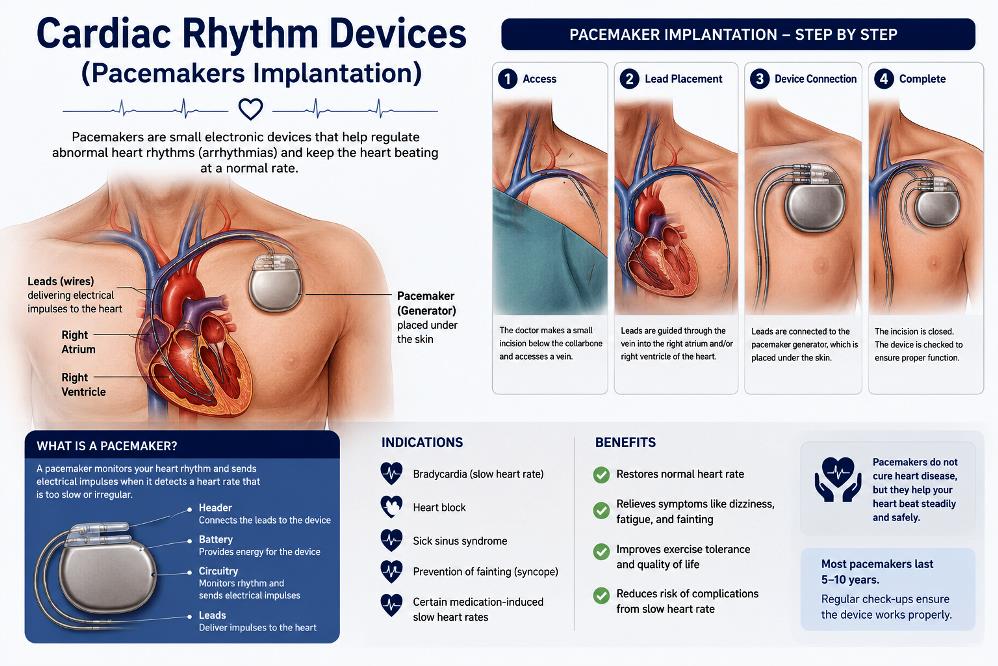
A pacemaker is a brilliant, miniature computer designed to act as a backup generator for your heart. If your heart’s natural electrical system fails, the pacemaker steps in to ensure your heart beats exactly when it should, at the perfect rate.
A standard pacemaker system consists of two main parts:
- The Generator (The Brain and Battery): This is a small, ultra-thin metal box (about the size of a matchbox or a stack of coins) that is placed just under the skin of your chest, near your collarbone. Inside the titanium casing is a powerful microscopic computer and a long-lasting lithium battery (which typically lasts 8 to 12 years).
- The Leads (The Wires): These are incredibly thin, flexible, insulated wires that are carefully threaded through a vein in your chest directly down into your heart. The tips of the wires attach securely to the heart muscle.
How it works: The pacemaker constantly “listens” to your heart. If your heart beats normally on its own, the pacemaker does absolutely nothing. It just waits and watches. However, if your heart pauses for too long, beats too slowly, or the signal gets blocked, the pacemaker instantly sends a tiny, painless electrical pulse down the wires to stimulate the heart muscle and force a heartbeat. You will not feel the shock; you will only feel the relief of a steady, reliable pulse.
Types of Cardiac Rhythm Devices Implantation in Kolkata
Not all heart rhythm problems are the same, which means there is no “one-size-fits-all” device. Dr. Ayan Kar carefully evaluates your specific condition to determine exactly which type of device will give you your life back.
We offer a complete spectrum of advanced Cardiac Rhythm Devices Implantation in Kolkata:
1. Standard Pacemakers (For Slow Heartbeats)
Used primarily to treat Bradycardia and Heart Block.
- Single-Chamber Pacemaker: Uses one wire placed in either the upper chamber or lower chamber of the heart.
- Dual-Chamber Pacemaker: Uses two wires—one in the upper chamber and one in the lower chamber. This allows the pacemaker to mimic the natural, synchronized squeeze of the heart perfectly.
- Leadless Pacemakers: A revolutionary new technology for specific patients. The entire pacemaker is the size of a large vitamin capsule. It has no wires and requires no chest incision. It is delivered through a catheter in the groin and implanted directly inside the heart muscle.
2. Implantable Cardioverter Defibrillator or ICD (For Dangerous Fast Heartbeats)
An ICD looks exactly like a pacemaker, but it is slightly larger and has a much more critical job. While a pacemaker speeds up a slow heart, an ICD is designed to save you from sudden cardiac death caused by dangerously fast rhythms.
- How it works: If an ICD detects that your heart has gone into a lethal, chaotic rhythm (Ventricular Fibrillation), it acts instantly. It delivers a powerful, life-saving electrical shock directly to the heart to “reboot” the system and restore a normal rhythm. It is literally having an emergency room paramedic inside your chest 24/7.
3. Cardiac Resynchronization Therapy / CRT (For Severe Heart Failure)
When a patient has advanced heart failure, the left and right sides of the heart often beat out of sync (dyssynchrony), making the heart terribly weak and inefficient. Standard pacemakers cannot fix this.
Dr. Kar specializes in CRT, also known as Biventricular Pacing.
- How it works: Instead of one or two wires, a CRT device uses three wires. One goes to the top chamber, one to the right lower chamber, and a special third wire is meticulously threaded to the outside of the left lower chamber. The device then sends signals to both the left and right sides simultaneously, forcing the heart to squeeze together in perfect, powerful harmony.
- The Impact: This therapy is miraculous for heart failure patients. It dramatically reduces shortness of breath, increases energy levels, shrinks the enlarged heart back closer to a normal size, and keeps patients out of the hospital.
- CRT-P vs. CRT-D: A CRT-P is a biventricular device that only functions as a pacemaker. A CRT-D is a biventricular device that also includes the shock-therapy capabilities of a defibrillator for maximum protection.
Warning Signs: Do You Need a Pacemaker?
Because electrical issues happen on the inside, the symptoms appear on the outside in ways that can often be confused with simply “getting older” or being tired. You should schedule a consultation with Dr. Ayan Kar immediately if you or a loved one experience any of the following:
- Unexplained Syncope (Fainting): Passing out suddenly without warning, often resulting in injuries or falls. This is the most urgent sign of a heart block.
- Severe Dizziness or Lightheadedness: Feeling like the room is spinning or that you might pass out when standing up or walking.
- Chronic, Crushing Fatigue: Feeling utterly exhausted regardless of how much sleep you get, because your heart is beating too slowly to deliver oxygen to your muscles.
- Shortness of Breath: Struggling to breathe during simple activities, like taking a shower or walking down a hallway (a major sign of heart failure).
- Palpitations: A feeling that your heart is fluttering, skipping beats, or doing “flip-flops” in your chest.
The Patient Journey: Step-by-Step Pacemaker Implantation Surgery
The thought of having a mechanical device implanted in your chest can be intimidating. However, Pacemaker Implantation Surgery in Kolkata is one of the safest, most routine, and highly successful procedures performed today.
Dr. Kar prioritizes your comfort, safety, and understanding. Here is a detailed, step-by-step walkthrough of exactly what happens.
Step 1: The Diagnostic Evaluation
Before any surgery is planned, we must prove that an electrical failure is the root of the problem. Dr. Kar will use non-invasive tests to map your heart’s rhythm:
- ECG (Electrocardiogram): A quick baseline reading of your electrical system.
- Holter Monitor: A wearable device that records every single heartbeat for 24 to 72 hours while you go about your normal day at home, helping us catch irregular rhythms that only happen occasionally.
- Echocardiogram (Echo): An ultrasound to measure how strong your heart muscle is and whether you need a standard pacemaker or a CRT device for heart failure.
Step 2: Preparing for Surgery
Once the need for a device is confirmed, our team will guide you through the preparation. The procedure is typically performed as a short-stay admission. You will be asked to fast (no food or water) for roughly 6 to 8 hours before the procedure. We will review your medications, especially blood thinners, and give you clear instructions on what to take.
Step 3: The Operating Room (Cath Lab) Environment
You will be taken to a specialized, sterile Cardiac Catheterization Laboratory. The environment is cool, and you will be surrounded by advanced X-ray monitors.
You will not be put into a deep sleep (general anesthesia) with a breathing tube. Instead, our team will give you conscious sedation through an IV line. You will feel incredibly relaxed, drowsy, and stress-free. You can still hear us and follow instructions, but you will not feel any anxiety or pain.
Step 4: The Implantation Process
- Numbing the Area: Dr. Kar will thoroughly clean the skin on your upper chest (usually just below the left or right collarbone). He will inject a local anesthetic to completely numb the skin and the tissue underneath. You will feel a tiny pinch, and then nothing but mild pressure.
- Creating the Pocket: A small incision (about 2 inches long) is made in the numb skin. Dr. Kar creates a small “pocket” under the skin and fatty tissue where the generator box will safely sit.
- Threading the Wires: Dr. Kar locates a large vein that runs under your collarbone. Using real-time X-ray imaging (fluoroscopy) as a map, he gently threads the thin pacemaker wires through the vein directly down into the chambers of your heart. Because there are no nerve endings inside your veins, you will not feel the wires moving.
- Securing the Wires: Once the wires are perfectly positioned in the heart muscle, they are tested extensively using computerized equipment to ensure they have an excellent electrical connection.
- Connecting the Brain: The other ends of the wires are securely plugged into the pacemaker generator box. The box is then tucked safely into the small pocket created under your skin.
- Closing Up: The incision is closed with special dissolvable stitches or surgical glue and covered with a sterile waterproof dressing.
The entire procedure typically takes about 1 hour for a standard pacemaker, or 2 to 3 hours for a complex CRT device.
Step 5: Immediate Recovery
You will be moved to a recovery room. Most patients stay overnight for observation. We will perform a chest X-ray to confirm the wires are sitting perfectly, and a device technician will connect a computer to your pacemaker (wirelessly, from outside your body) to program the settings precisely for your unique needs.
The next morning, assuming everything is perfect, you will walk out of the hospital and go home.
Life After Surgery: Long-Term Management and Safety
Getting a pacemaker is not just a surgery; it is a lifelong partnership in health. Many patients are surprised to find out that within a few weeks, they completely forget the device is even there.
The First Few Weeks (Healing)
- You will have some mild bruising and tenderness around the incision site for a few days.
- The “Arm Rule”: For the first 4 to 6 weeks, you must avoid lifting the arm on the side of your pacemaker above your shoulder, and avoid lifting anything heavier than 5 to 10 pounds. This restriction gives the tiny wires time to heal and firmly scar into the heart muscle so they do not pull out of place.
Returning to Normal Life
Once healed, you can return to virtually every activity you loved before. You can swim, play golf, travel, engage in intimate relations, drive a car, and play with your grandchildren. The device is there to let you live your life, not restrict it.
Navigating the Modern World (Safety FAQs)
Patients often worry about how electronics will interact with their new device. Modern pacemakers are incredibly well-shielded, but here is what you need to know:
- Household Appliances: Microwaves, televisions, electric blankets, computers, and blenders are 100% safe. They will not affect your pacemaker.
- Cell Phones: Your cell phone is safe to use. However, out of an abundance of caution, you should hold the phone to the ear on the opposite side of your pacemaker, and avoid keeping the phone in a shirt pocket directly over the device.
- Airport Security: You will be given a Pacemaker Identification Card. Show this to the security agents. The metal in the device may set off the metal detector archway. Walking through the archway is safe, but agents should avoid holding a handheld security wand directly over your chest for a prolonged period. They will perform a manual pat-down instead.
- MRI Machines: Historically, patients with pacemakers could never get an MRI scan because the magnets would destroy the device. Today, Dr. Kar implants MRI-Conditional pacemakers. If you ever need an MRI in the future, your pacemaker can be temporarily switched to a “safe mode” by a technician, allowing you to get the scan safely.
Long-Term Management and Battery Replacement
Your pacemaker requires routine check-ups. You will visit the clinic 2 to 3 times a year. During these visits, Dr. Kar or a technician will place a wand over your chest to wirelessly download data from the device. We can see if your heart had any irregular rhythms, check the wire connections, and check the exact battery level.
When the battery finally runs low (after 8 to 12 years), it does not stop suddenly. It gives us months of warning. Because the battery is sealed inside the generator box, the entire box must be replaced. This is a very minor, 30-minute day-care procedure. The old wires are left in place and simply plugged into a brand new box.
Why Choose Dr. Ayan Kar for Your Device Therapy?
When you are having a computer implanted into your heart, you want the hands of a master technician.
Widely regarded as the Best Doctor for Pacemaker Implantation in Kolkata, Dr. Ayan Kar brings over 16 years of rigorous clinical experience to the field of advanced cardiac care. He is not just a general cardiologist; he is the Lead in Heart Failure Services at the premier Rabindranath Tagore International Institute of Cardiac Sciences (RTIICS).
His expertise extends far beyond simple, routine pacemakers. Dr. Kar specializes in the highly complex implantation of CRT-D and CRT-P devices for patients battling refractory heart failure, a procedure that requires extraordinary precision, spatial awareness, and deep anatomical knowledge.
When you choose Dr. Kar, you are choosing a doctor who utilizes structured, protocol-driven care. He prioritizes patient education, ensuring that you and your family understand exactly why a device is needed, how it will be placed, and what it will do for your future. His compassionate, patient-first approach guarantees that you will never feel like just another number in a busy system.
Areas of Treatments:
Book Your Consultation with Dr. Ayan Kar
Don't wait for your symptoms to worsen. Early intervention is the key to successful heart failure management. Contact our clinic today to schedule a comprehensive cardiovascular evaluation and take the first step toward a stronger, healthier heart.
Call NowGet an AppoinmentFrequently Asked Questions about Cardiac Rhythm Devices (Pacemakers Implantation) in Kolkata
What is involved in Pacemaker Implantation Surgery in Kolkata?
Pacemaker Implantation Surgery in Kolkata is a highly safe, minimally invasive procedure where a small electronic generator is placed just under the skin near your collarbone. Thin wires are gently guided through a vein directly into your heart to regulate your heartbeat. The procedure is typically performed under local anesthesia and conscious sedation, taking about 1 to 2 hours.
How can I find the Best Doctor for Pacemaker Implantation in Kolkata?
When looking for the Best Doctor for Pacemaker Implantation in Kolkata, it is essential to choose a highly experienced interventional cardiologist specializing in electrophysiology and device therapy. Dr. Ayan Kar is widely recognized for his precision in complex pacemaker and CRT device implantations, offering world-class care and long-term heart rhythm management.
Is a pacemaker considered an effective Arrhythmia Treatment Kolkata?
Yes, a pacemaker is one of the most reliable and effective forms of Arrhythmia Treatment Kolkata. It is specifically designed to treat bradycardia (a dangerously slow heartbeat) and heart block. By continuously monitoring your heart's electrical system, the pacemaker instantly delivers a painless electrical pulse to correct the rhythm whenever it detects a skipped or delayed beat.
What is the recovery time after getting a pacemaker implanted?
Recovery is generally very quick. Most patients stay in the hospital overnight for observation and can walk out the next day. While you can return to normal light activities almost immediately, you will be advised to avoid heavy lifting and restrict raising the arm on the side of the implantation above your shoulder for about 4 to 6 weeks to allow the device wires to settle securely.
Reclaim Your Rhythm. Reclaim Your Life.
You do not have to live in fear of fainting, and you do not have to accept the crushing fatigue of heart failure as your permanent reality. Modern medical technology has provided a solution, and expert help is available right here in your city. If you have been diagnosed with an arrhythmia, are experiencing unexplained dizzy spells, or have been told you need a pacemaker or an ICD, it is time to take action. Contact Dr. Ayan Kar’s clinic today to schedule a comprehensive cardiac consultation. Let us help you restore your heart’s natural rhythm so you can get back to living a confident, energetic, and uninterrupted life.Book Your Consultation with Dr. Ayan Kar
Don't wait for your symptoms to worsen. Early intervention is the key to successful heart failure management. Contact our clinic today to schedule a comprehensive cardiovascular evaluation and take the first step toward a stronger, healthier heart.
Call NowGet an Appoinment