Radial Angioplasty Treatments: Expert Minimally Invasive Heart Care
Discover radial angioplasty, the modern, minimally invasive technique for clearing heart blockages through the wrist artery.
Advanced Radial Angioplasty Treatments in Kolkata, India
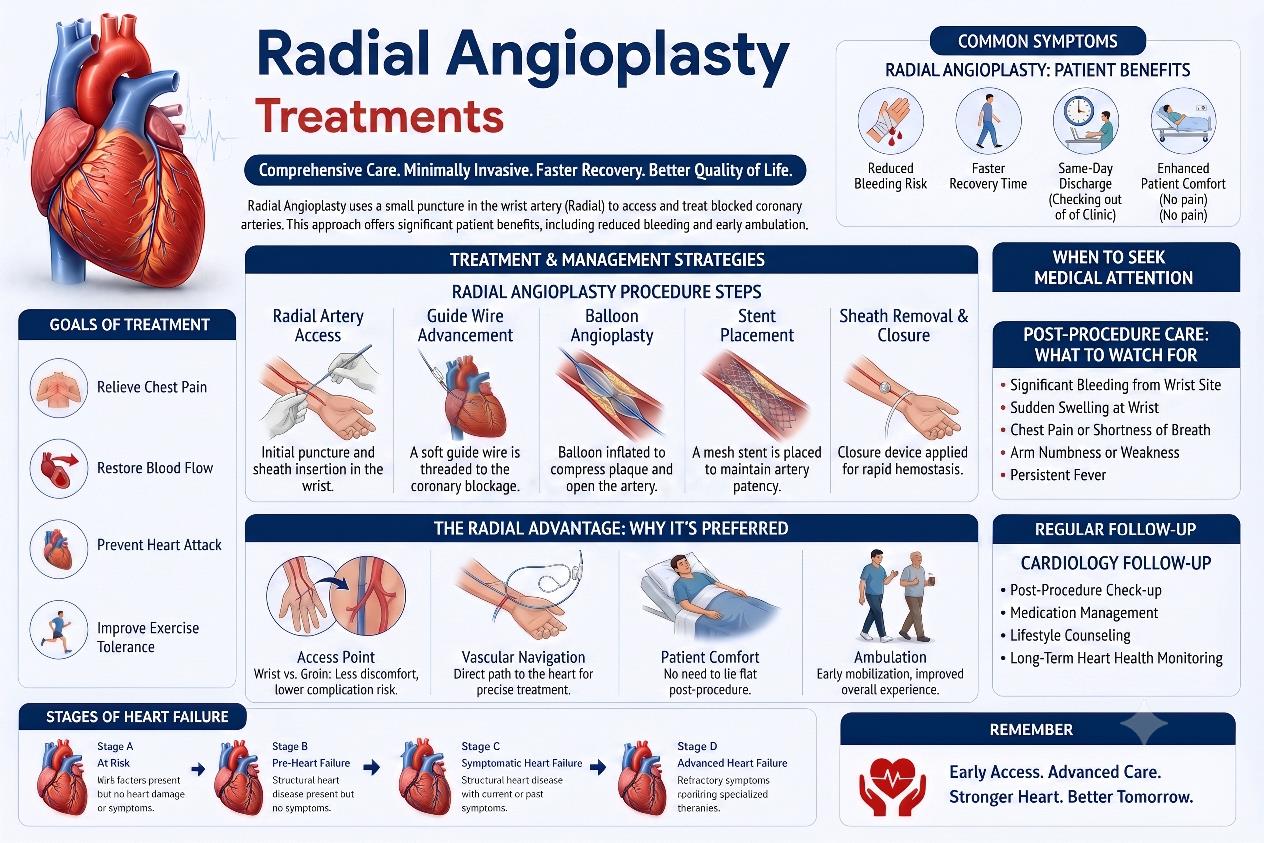
Expert Minimally Invasive Heart Care with Dr. Ayan Kar
A New Era in Heart Care: Fixing the Heart Through the Wrist
Hearing the words, “You have a blockage in your heart,” is one of the most frightening moments a person can experience. Instantly, your mind fills with questions, anxieties, and images of major surgery, long hospital stays, and painful recoveries. For decades, treating a blocked heart artery meant a highly invasive procedure, often requiring patients to lie flat on their backs for hours with a heavy sandbag pressing down on their groin to prevent bleeding.
But medical science has evolved, and today, there is a vastly superior, more comfortable, and much safer way.
Welcome to the modern era of Radial Angioplasty.
Under the expert guidance of Dr. Ayan Kar, our clinic specializes in this revolutionary, minimally invasive technique. Instead of accessing the heart through the large femoral artery in the groin, radial angioplasty focuses specifically on clearing heart blockages through the radial artery in your wrist.
This might sound like science fiction—fixing the heart through the wrist—but it is a highly proven, incredibly safe, and elegantly simple medical reality. By choosing this modern approach, Dr. Kar ensures that your life-saving heart procedure feels less like a major surgery and more like a routine outpatient visit. You can sit up immediately, enjoy a cup of tea, and often walk out of the hospital the very same day.
This comprehensive guide is designed to remove the fear of the unknown. We will walk you through exactly what radial angioplasty is, how it works, why it is safer, and what you can expect every step of the way.
Understanding the Problem: What Are Heart Blockages?
Before we explain the solution, it is important to understand the problem in simple terms.
Think of your heart as an engine that runs 24 hours a day, 7 days a week, from the moment you are born. To keep pumping, this muscle needs a constant, rich supply of oxygen and nutrients. This fuel is delivered by a network of “pipes” called the coronary arteries.
Over time—due to age, genetics, high cholesterol, diabetes, high blood pressure, or lifestyle habits like smoking—a sticky substance called plaque begins to build up on the inner walls of these pipes. Plaque is made of fat, cholesterol, calcium, and other substances found in the blood.
As plaque accumulates, it hardens and narrows the artery, much like rust clogging an old water pipe. This condition is known as Coronary Artery Disease (CAD). When the pipe becomes too narrow, the heart muscle struggles to get enough oxygen, especially when you are active. This “starvation” of the heart muscle causes symptoms like:
Chest pain, tightness, or pressure (Angina)
Shortness of breath during mild physical activity
Unexplained fatigue
Pain radiating to the left arm, jaw, or back
If the plaque suddenly ruptures, a blood clot can form, completely blocking the artery. This causes a heart attack.
The goal of angioplasty is to go inside that blocked pipe, push the plaque out of the way, and permanently prop the artery open so blood can flow freely again. The question is: How do we get to the heart to do this?
What is Radial Angioplasty?
Angioplasty itself is not a new procedure, but the pathway we take to get to the heart has changed dramatically.
In medical terms, “angio” refers to blood vessels, and “plasty” means to form or repair. To repair the blocked artery, Dr. Ayan Kar uses a catheter—a long, ultra-thin, flexible, hollow tube.
In a traditional angioplasty, this tube is inserted into the femoral artery, which is located deep in the groin. From the groin, the tube is threaded all the way up through the abdomen and into the heart.
Radial Angioplasty (also known as the Transradial Approach) completely changes this entry point. Instead of the groin, Dr. Kar accesses your vascular system through the radial artery, which is located on the inside of your wrist, just below the base of your thumb (the exact spot where a doctor checks your pulse).
Because the entire blood vessel system in the human body is connected, a catheter inserted at the wrist can easily be navigated up the arm, across the shoulder, and down into the heart. Once the catheter reaches the blockage, microscopic tools—like tiny inflatable balloons and metal mesh stents—are passed through the tube to clear the blockage and secure the artery.
This small shift in the entry point—from the groin to the wrist—creates a massive, positive shift in the patient’s overall experience, safety, and recovery.
The Old Way vs. The Modern Way: Groin vs. Wrist
To truly appreciate the value of radial angioplasty, it helps to compare it to the traditional method.
| Feature | Traditional Femoral (Groin) Approach | Modern Radial (Wrist) Approach |
| Bleeding Risk | Higher risk; artery is deep and large. | Very low risk; artery is small and superficial. |
| Post-Procedure Rest | Must lie perfectly flat on your back for 6-8 hours. | No bed rest required. You can sit up immediately. |
| Bleeding Control | Heavy sandbag or mechanical clamp on the groin. | A comfortable, watch-like pressure band on the wrist. |
| Mobility | Cannot walk or use the restroom independently. | Can walk, eat, and use the restroom right away. |
| Hospital Stay | Usually requires an overnight stay. | Often done as a same-day discharge procedure. |
| Patient Privacy | Requires exposure of the groin area. | High privacy; only the wrist is exposed. |
As you can see, the radial approach is designed entirely around patient comfort and safety. It takes a procedure that used to feel incredibly invasive and turns it into a streamlined, highly manageable experience.
The Incredible Benefits of Choosing the Wrist
Dr. Ayan Kar strongly advocates for the transradial approach whenever medically possible because the clinical and psychological benefits are undeniable. Here is a deeper look at why this technique is the gold standard for modern heart care:
1. Drastically Reduced Risk of Bleeding Complications
The femoral artery in the groin is a massive blood vessel located deep beneath the skin and muscle. If bleeding occurs after the catheter is removed, it can pool internally, creating a large, painful bruise (hematoma) or requiring a blood transfusion.
The radial artery in the wrist, however, is very small and sits directly over the wrist bone, right under the skin. If there is any bleeding, it is instantly visible. More importantly, because the artery is sitting against a hard bone, it is incredibly easy to compress and stop the bleeding. The risk of major bleeding complications with radial angioplasty is nearly zero.
2. Immediate Mobility and Ultimate Comfort
The most common complaint patients have about traditional groin angioplasty isn’t the procedure itself—it is the agonizing recovery. Lying perfectly flat on your back without bending your legs for up to 8 hours can cause severe lower back pain and extreme frustration.
With radial angioplasty, there are no bed-rest restrictions. As soon as the procedure is over, you can sit up in a chair, drink water, have a meal, read a book, and safely walk to the restroom. Your legs are completely unaffected.
3. Faster Discharge and Return Home
Because the risk of bleeding is so low and mobility is immediate, patients who undergo radial angioplasty recover much faster. If you are having a planned, non-emergency stent placement, you will likely be discharged the very same evening. You get to sleep in your own bed, rather than spending a restless night in a hospital ward.
4. Psychological Reassurance
Heart procedures are stressful. The groin approach requires patients to be partially undressed, which can feel invasive and embarrassing. The radial approach is performed with you fully clothed in a hospital gown, with only your arm resting on a specialized board. It feels far less like major surgery and more like having blood drawn or an IV placed, which vastly reduces patient anxiety.
5. Built-In Safety: The Hand’s Dual Blood Supply
A common fear patients have is: “If you put a tube in my wrist artery, will my hand lose blood supply?” The answer is a definitive no, thanks to brilliant human anatomy. The hand receives blood from two distinct arteries: the radial artery (on the thumb side) and the ulnar artery (on the pinky side). They form a loop in the hand. If the radial artery is temporarily blocked by the catheter, the ulnar artery simply takes over and supplies 100% of the blood your hand needs. Your hand is completely safe.
Step-by-Step: What to Expect on Procedure Day
Fear thrives in the unknown. Dr. Ayan Kar believes that an informed patient is a calm patient. To help you prepare mentally and emotionally, here is a detailed, step-by-step walkthrough of exactly what happens when you come in for a radial angioplasty.
Step 1: Pre-Procedure Preparation
When you arrive at the hospital, our friendly nursing staff will welcome you. You will be asked to change into a comfortable hospital gown. We will check your vital signs (blood pressure, heart rate, and oxygen levels). An IV line will be placed in your opposite arm or hand to deliver fluids and medications. Before proceeding, Dr. Kar or a nurse will perform a simple test called the Allen’s Test. They will press firmly on both the radial and ulnar arteries in your wrist for a few seconds to briefly stop blood flow to your hand, then release the ulnar artery. This is a safety check to ensure your ulnar artery is perfectly capable of supplying blood to your hand during the procedure.
Step 2: The Cath Lab Environment
You will be wheeled into the Cardiac Catheterization Laboratory (often called the Cath Lab). It looks like a high-tech operating room filled with large X-ray monitors. The room is kept cool to protect the advanced computers. You will lie down on a padded table. Your right arm (usually) will be extended outward and resting comfortably on an armboard.
Step 3: Local Anesthesia (No Deep Sleep Required)
You do not need general anesthesia for this procedure. You will be awake and breathing on your own. Through your IV, you will be given a mild, conscious sedative. You will feel incredibly relaxed, drowsy, and detached from any anxiety, but you will still be able to hear Dr. Kar and follow simple instructions. Your wrist area is cleaned with a cold antiseptic solution. Dr. Kar will then inject a local numbing medication (lidocaine) just under the skin of your wrist. This is the only part of the procedure where you might feel a tiny pinch or burn, similar to a bee sting. Within seconds, your wrist will be completely numb.
Step 4: Placing the Gateway (The Sheath)
Once the wrist is numb, Dr. Kar makes a microscopic puncture in the radial artery. Through this pinhole, a tiny plastic tube called a “sheath” is inserted. This sheath acts as a protective gateway, allowing tools to go in and out of the artery without scraping the vessel walls. You will feel some mild pressure, but absolutely no pain.
Step 5: The Journey to the Heart
Through the sheath, the long, thin catheter is smoothly guided up your arm, through your shoulder area, and down to the coronary arteries on the surface of your heart. Will you feel the tube inside you? No. Human blood vessels do not have nerve endings inside them. You cannot feel the catheter moving, tracking, or resting inside your body.
Step 6: The Angiogram (Mapping the Blockage)
Once the catheter is in place, Dr. Kar injects a special, safe contrast dye through the tube. At the same time, the X-ray camera above you starts recording. The dye makes your blood vessels light up on the monitors, acting like a GPS map. It clearly shows Dr. Kar exactly where the blockages are, how long they are, and how severe the narrowing is. When the dye is injected, you might feel a brief, warm flush spread through your body—this is entirely normal and passes in seconds.
Step 7: The Angioplasty (Clearing the Road)
If a severe blockage is identified, Dr. Kar will proceed to fix it immediately. A specialized catheter equipped with a microscopic, tightly folded balloon is guided directly into the center of the blockage. Once perfectly positioned, the balloon is gently inflated with fluid. As the balloon expands, it acts like a snowplow, forcefully pushing the hardened plaque outward against the walls of the artery. This immediately crushes the blockage and opens the pathway for blood to flow. During the balloon inflation, blood flow is briefly paused for a few seconds. You may feel a temporary pressure or mild ache in your chest. This is normal and means the balloon is doing its job. The feeling goes away as soon as the balloon is deflated.
Step 8: The Stent Placement (The Permanent Scaffold)
If we simply deflated the balloon and walked away, the artery could eventually collapse back down. To ensure the artery stays wide open permanently, Dr. Kar places a Stent. A stent is a microscopic, expandable tube made of an advanced medical-grade metal alloy mesh. It looks like the tiny spring inside a retractable pen. The stent is mounted over the deflated balloon. When the balloon is inflated, it forces the metal stent to expand and lock into the walls of the artery. The balloon is then deflated and removed, but the metal stent remains behind permanently, acting as a strong scaffold to hold the artery open. Note: Dr. Kar exclusively uses advanced Drug-Eluting Stents (DES). These stents are coated with a slow-release medication that prevents your body’s scar tissue from growing over the metal, ensuring the pipe stays clean and clear for years.
Step 9: The Finishing Touch (The TR Band)
Once the artery is fixed and blood is flowing beautifully, Dr. Kar removes the catheter and the plastic sheath from your wrist. There are no stitches required. Instead, a special, clear plastic wristband—called a TR Band (Transradial Band)—is wrapped around your wrist. It looks like a thick wristwatch. It contains a small air bladder that presses firmly against the pinhole in your artery to stop the bleeding.
Step 10: Recovery
You are instantly moved to a comfortable recovery room. Because you had a radial angioplasty, you can sit up immediately. Within 30 minutes, you can have a cup of tea or a light meal. Over the next few hours, the nursing staff will slowly let the air out of your wristband to reduce the pressure. Once they confirm there is no bleeding, the band is removed entirely and replaced with a simple bandage. If you feel well and your vitals are stable, Dr. Kar will discharge you to go home to your family.
Is Everyone a Candidate for Radial Angioplasty?
While radial angioplasty is the preferred method for the vast majority of patients, there are a few rare exceptions where Dr. Kar might need to use the traditional groin approach.
The wrist approach might not be suitable if:
Your radial artery is too small: Some individuals simply have very narrow arteries in their arms, making it difficult to pass the equipment safely.
The Allen’s Test is negative: If the ulnar artery on the other side of your wrist cannot supply enough backup blood to your hand, the radial artery cannot be safely used.
Complex, multi-vessel disease: Sometimes, extremely complex blockages require larger catheters that cannot fit through the wrist.
Kidney dialysis patients: Patients with an AV fistula in their arm for dialysis cannot have a catheter placed in that arm.
During your initial consultation, Dr. Kar will perform all necessary checks to determine if you are a perfect candidate for the radial approach.
Life After the Procedure: Protecting Your Heart
Radial angioplasty is a miraculous mechanical fix for a blocked artery, but it is not a cure for the underlying disease that caused the plaque to build up in the first place. Your new stent has opened the road, but it is your responsibility to keep it clear.
Dr. Kar emphasizes that post-procedure care is a true partnership between the doctor and the patient. To protect your investment in your health, you must adhere to the following guidelines:
1. Medication is Non-Negotiable
Your body recognizes the new metal stent as a foreign object, and its natural instinct is to form a blood clot over it. To prevent this, Dr. Kar will prescribe powerful antiplatelet medications (blood thinners) such as Aspirin combined with Ticagrelor, Prasugrel, or Clopidogrel. You must take these medications exactly as prescribed every single day. Stopping these medications abruptly without Dr. Kar’s permission can cause a sudden, massive blood clot inside the stent, leading to a fatal heart attack.
2. Caring for the Wrist
For the first 48 to 72 hours, you should avoid heavy lifting, pushing, or pulling with the arm that was used for the procedure. Do not wring out wet towels or carry heavy grocery bags. The pinhole needs time to seal completely. After a few days, you can return to full normal use of your hand and arm.
3. Dietary Overhaul
Plaque is fed by bad cholesterol. You must adopt a heart-healthy diet. Significantly reduce your intake of saturated fats, red meat, deep-fried foods, and processed sugars. Increase your consumption of leafy green vegetables, fresh fruits, whole grains, and lean proteins like fish and chicken.
4. Physical Activity
Once your wrist has healed and Dr. Kar clears you (usually within a week), you need to get moving. The heart is a muscle, and exercise makes it stronger. Aim for 30 to 45 minutes of brisk walking, cycling, or swimming at least 5 days a week.
5. Quit Smoking Immediately
There is no compromise here. Smoking damages the lining of your blood vessels, makes your blood sticky, and accelerates plaque growth at a terrifying rate. If you continue to smoke, your new stent is at high risk of clogging. Seek help, use patches, or join a support group, but the cigarettes must go.
Why Choose Dr. Ayan Kar?
When it comes to your heart, precision, experience, and technique matter above all else.
Dr. Ayan Kar is a highly skilled interventional cardiologist who has dedicated his practice to mastering minimally invasive, transradial techniques. By choosing our clinic, you are not just getting a doctor who can clear a blockage; you are getting a specialist who prioritizes your comfort, champions your rapid recovery, and treats you with the empathy and respect you deserve.
We utilize state-of-the-art Cath Lab technology, employ advanced drug-eluting stents, and maintain an uncompromising standard of patient safety. From your very first consultation to your final follow-up, Dr. Kar and our dedicated clinical team will be by your side, answering your questions and guiding you toward a longer, healthier life.
Areas of Treatments:
Book Your Consultation with Dr. Ayan Kar
Don't wait for your symptoms to worsen. Early intervention is the key to successful heart failure management. Contact our clinic today to schedule a comprehensive cardiovascular evaluation and take the first step toward a stronger, healthier heart.
Call NowGet an AppoinmentFrequently Asked Questions (FAQs)
Q: Does radial angioplasty hurt?
No. The local anesthetic numbs your wrist entirely. You will feel a tiny pinch during the numbing injection, and you might feel a brief, dull ache in your chest when the balloon is inflated inside the heart. Overall, patients report that the procedure is highly tolerable and virtually pain-free.
Q: How long does the procedure take?
A diagnostic angiogram takes about 15 to 20 minutes. If Dr. Kar proceeds to do an angioplasty and place a stent, the total time in the Cath Lab is usually between 45 minutes to an hour.
Q: Will the stent move or rust inside my body?
No. Once the stent is expanded by the balloon, it is permanently locked into the artery wall. It cannot shift, move, or slip, even if you exercise vigorously or experience chest trauma. Furthermore, modern stents are made of surgical-grade alloys (like cobalt-chromium) that will never rust or degrade in your bloodstream.
Q: Can I go through airport security with a stent in my heart?
Yes. Heart stents are microscopic and will not trigger airport security metal detectors. You do not need to carry a special card or doctor’s note for airport travel.
Q: Can I have an MRI scan if I have a stent?
Most modern stents placed by Dr. Kar are completely MRI-safe. However, it is always recommended to tell the MRI technician that you have a cardiac stent before undergoing any scanning procedure.
Q: How soon can I return to work?
Because radial angioplasty avoids the trauma of a groin puncture, recovery is exceptionally fast. If you have a sedentary job (desk work), you can usually return to work within 3 to 5 days. If your job involves heavy lifting or intense manual labor, you may need to take 1 to 2 weeks off. Dr. Kar will provide personalized timelines based on your specific situation.
Take Control of Your Heart Health Today
You do not have to live in fear of heart blockages, and you do not have to endure the painful recoveries of the past. Modern medicine has provided a better way.
If you are experiencing chest pain, shortness of breath, have been diagnosed with Coronary Artery Disease, or simply want a second opinion on a recommended heart procedure, we are here to help.
Contact Dr. Ayan Kar’s clinic today to schedule your comprehensive cardiac consultation. Let us help you heal your heart, through your wrist, so you can get back to living your life without missing a beat.
Book Your Consultation with Dr. Ayan Kar
Don't wait for your symptoms to worsen. Early intervention is the key to successful heart failure management. Contact our clinic today to schedule a comprehensive cardiovascular evaluation and take the first step toward a stronger, healthier heart.
Call NowGet an Appoinment